
Camera inspection: $300–$750
The first and non-negotiable step. Most operators credit it against the works if you proceed.
Relining turns a recurring drainage problem into a finished one. The joints that roots come through are sealed along the whole run, so there is no way back in, and nothing above the pipe gets disturbed to do it.
Relining is a structural repair, not a cleaning method, and the distinction matters when you are comparing quotes. Jetting restores flow through a pipe that is still cracked. A liner restores the pipe.
That also means it is not always the answer. It cannot correct a run that has sagged or lost its fall, and it has nothing to line against where a section has collapsed. A camera survey separates those cases in about an hour, and the answer changes the cost by a multiple.

The older streets near the station still run original earthenware drains whose joints have opened after sixty years of ground movement.
Houses of this era were generally drained in vitrified clay, laid well, and then left alone for sixty or seventy years. The pipe is usually still round and still sound. The joints have had seven decades of ground movement and root pressure.
That combination is close to the textbook relining case, which is why so much no-dig work in Sydney happens on streets built between the late 1940s and the 1960s.
On stable ground a short patch over a single defect is often the proportionate repair. On reactive soil it frequently is not, because the movement that opened one joint has been working on every other joint in the same run for the same number of years.
That is worth knowing when you compare quotes. The cheaper patch can be the right call, but on this ground the full-length liner is more often the one that ends the problem rather than relocating it a metre.
In a strip of tenancies the drainage is frequently shared, which means the fault is often not under the premises reporting it, and the party who pays is not always the party who called.
That is worth settling before the quote rather than after. Camera footage with distances marked from a known access point is what makes the conversation with a landlord or a neighbouring tenant short, because it shows exactly where the defect sits.
Holsworthy (postcode 2173) sits in Sydney’s south-west between Heathcote Road, the rail line and the bushland of the military reserve, bordered by Wattle Grove, Hammondville and Moorebank across the Georges River country. Homes from the 1960s onward, sandy soils and encroaching bushland give its drains a distinct local character.
Ground near water holds more of it, sits lower and moves more through the seasons than ground further up. Pipework laid decades ago has been flexed by that movement for its whole life, and joints open a fraction at a time rather than failing all at once.
It is why faults here tend to arrive as a slow decline rather than a sudden break, and why a camera often finds a run that is uniformly tired instead of one obvious defect. That pattern suits a full-length liner rather than a patch.
The suburb’s sandy, falling ground sheds stormwater quickly toward Harris Creek, overwhelming silted or undersized lines during heavy rain.
Most people associate relining with sewers, but stormwater suffers the same failures and reline just as well: cracked lengths, open joints, roots, and sections that have silted because the fall has flattened. On a property that floods in every serious downpour, the line is often the reason rather than the rain.
The camera run matters more here than anywhere. Clearing a surcharging pit at the height of a storm tells you almost nothing; the same line inspected on a dry day tells you whether you have a blockage or a defect.
Eucalypts along the reserve edges and older street plantings push roots into ageing clay joints, the most common blockage we clear across Holsworthy.
Clay is rigid, round and predictable, and that geometry is exactly what a liner wants. The resin sleeve cures hard against a barrel that holds its shape, and the short pipe lengths that make clay joint-heavy are the same joints the liner seals in one pass.
So the material that causes the most recurring blockages in older streets is also the easiest to repair properly without digging. That is a genuinely lucky combination and it is why relining suits this housing stock so well.
Where the water table sits close to the pipe, every open joint is an entry point. The line runs fuller than it should year-round, silt comes in with the water, and the system behaves as though it is undersized when it is simply leaking inward.
Sealing the run changes that immediately, and it is one of the clearest before-and-after results relining produces. It is also the case most often missed, because nothing looks broken from the surface.
The first and non-negotiable step. Most operators credit it against the works if you proceed.
Domestic sewer across Sydney in 2026. Longer single runs sit at the lower end of it.
Seals one defect. Right where the rest of the run is sound and the ground is stable.
Length, diameter and how many branches need reinstating are what move the number inside that band.
Excavation is only half the cost. Replacing the driveway or garden above it is the other half.
Figures reflect the 2026 Sydney market rather than a quote. You get your own number once we have seen inside the pipe. Figures here are indicative of the 2026 Sydney market rather than a quote from us, you get your own number as a fixed price before any work starts.

We find the fault, measure it from an access point, and check the fall is intact. That last check is what stops a liner being installed into a belly.
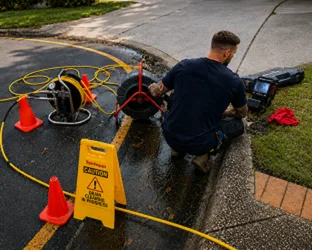
Per metre, with access and junction reinstatement itemised, and the excavation comparison alongside it so you can see both.
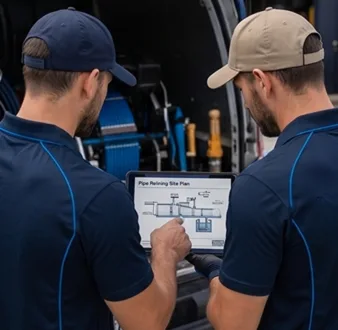
Clean, install, cure. One access point, one day for most homes, and no trench across the property.

Branches reopened, final footage, certificate and notification. Keep it with the property file, it is worth real money at sale.
Describe what the drain is doing and how often. We will tell you whether it sounds structural or whether a clean and a maintenance interval is the honest answer.
Straight answers on price, durability and when to dig instead.

Call for the fastest answer, or send the form and we will arrange a camera survey before anything is quoted.

Leave your details and our local Holsworthy team will call you back fast.